Tuesday, 27 May 2025

Ages of Search: From Commands to Conversations

Imagine you need to get from Los Angeles to New York to visit your sister, but you're on a tight budget. How would this conversation play out across three decades of search technology?


1995 - The Command

You type: cheap flights Los Angeles New York The computer returns 10,000 pages containing those exact words—including a poetry blog that mentions "cheap thrills," an article about Los Angeles architecture, and someone's travel diary from New York. 

You spend the next two hours going through irrelevant results, gradually learning to speak the computer's rigid language.

2015 - The Interpretation

You search: "Best way to get from LA to NYC" Google understands you want travel options and shows flight comparison tools, bus routes, and train schedules. 

Much better! But you still need to do all the work—comparing prices, checking dates, figuring out the tradeoffs.

2025 - The Collaboration

You tell an AI: "I need to visit my sister in New York next month, but I'm on a tight budget" 

AI responds: "I'd be happy to help! What dates work for you, and what's your budget range? I can also check if there are better deals on nearby airports or alternative dates. Would you consider a bus or train if it saves significantly?"

This isn't just about better search results—it's about a fundamental shift in how humans and computers communicate. We've evolved from rigid commands to natural collaboration, mirroring the evolution of human conversation itself.


Age I: The Librarian Era (1990s-2000s)

When computers were very fast, very literal librarians

In the beginning, search engines were like that ultra-efficient but painfully literal librarian who would only help if you asked in exactly the right way. You wanted information about cars? You better not say "automobile" or "vehicle"—the computer knew what you typed, not what you meant.

How the Librarian Worked

The technical foundation was elegantly simple: computers built massive indexes of every word on every webpage, then used algorithms like TF-IDF and PageRank to rank results. Think of it as the world's largest, fastest card catalog system. When you searched for "red shoes," the computer found every document containing both "red" and "shoes" and ranked them by relevance signals like how often those words appeared and how many other sites linked to them.


This approach is very innovative:

Lightning Speed: Results appeared in milliseconds 

Perfect Precision: Great for exact technical lookups

Transparent Logic: You knew exactly why you got specific results 

Predictable: The same query always returned the same results

When the Librarian Shined

Keyword search was perfect for anyone who spoke the system's language. Lawyers searching legal databases, developers hunting through code repositories, and researchers looking for specific technical terms all thrived in this era. If you knew the exact terminology and needed exact matches, nothing beat keyword search.


Breaking Point

But some of critical failures exposed the limitations:

The Vocabulary Mismatch Crisis: Normal people think "heart attack," doctors write "myocardial infarction." Normal people say "car," auto websites say "vehicle" or "automobile." The computer couldn't bridge this gap.

Boolean Rigidity: users must think like programmers

No Semantic Relationship: cannot understand dog and puppy are related.

Long-Tail Problem: By the 2000s, 70% of searches were unique, multi-word phrases. "Best pizza place near downtown with outdoor seating" simply couldn't be handled by exact keyword matching.

Mobile Revolution: Voice search made keyword precision impossible. Try saying "Boolean logic" to Siri, Alexa etc and see what happens.


Age II: Translator Era (2000s-2020s)

Teaching computers to understand meaning, not just match letters

Breakthrough question shifted from "What did they type?" to "What did they mean?"

Suddenly, computers learned that "puppy" and "dog" were related, that "inexpensive" and "cheap" meant the same thing, and that someone searching for "apple" might want fruit recipes or stock information depending on the context.

Technical Revolution

The magic happened through vector embeddings—a way of representing concepts as coordinates in mathematical space. Words and phrases with similar meanings ended up close together in this multidimensional space. It's like teaching a computer that "Paris, France" and "City of Light" should be neighbors in concept-space, even though they share no letters.

The architecture evolved from simple index lookup to sophisticated understanding: Query → Intent Analysis → Vector Similarity → Contextual Ranking → Enhanced Results


Real-World Transformations

Google's Knowledge Graph changed everything. Instead of just returning links, Google started understanding entities and relationships. Search for "Obama" and get direct answers about the former president, not just a list of web pages mentioning his name.

Amazon's Recommendations stopped being "people who bought X also bought Y" and became "people who like dark psychological thrillers might enjoy this new release"—even for books with completely different titles and authors.

Netflix's Discovery learned to understand that you enjoy "witty workplace comedies with strong female leads" without you ever typing those words.

Context Awareness Breakthrough

The same query now meant different things to different people:

  • "Apple" returns fruit recipes for food bloggers, stock information for investors
  • "Pizza" automatically means "pizza near me"
  • "Election results" means the current election, not historical data

Some of the major breakthrough in this age include 

Google PageRank Evolution

Knowledge Graph  - Direct answer instead of links 

BERT - Understanding context and nuance in natural language 

Personalisation at Scale -  Different results for different users based on context

Mobile first search - Understanding voice query and local intent


New Limitations Emerged

While semantic search solved the vocabulary mismatch problem, it created new challenges:

The Black Box Problem: Users couldn't understand why they got specific results 

Computational Intensity: Required significant processing power compared to keyword search 

Bias Amplification: Training data prejudices got reflected in results 

Still Reactive: The system waited for users to initiate searches


Age III: The Consultant Era (2020s-Present)

From search engine to research partner

The fundamental question evolved again: from "What information exists about X?" to "How can I solve problem X?"

Instead of just finding information, AI agents now break down complex problems, use multiple tools, maintain conversation context, synthesize insights from various sources, and proactively suggest next steps.

Superpowers of AI Agents

  • Multi-Step Reasoning: Breaking "plan my wedding" into venue research, catering options, budget optimization, and timeline coordination
  • Tool Integration: Using APIs, databases, calculators, and other services seamlessly
  • Conversational Memory: Remembering what you discussed three questions ago
  • Synthesis: Creating new insights by connecting information from multiple sources
  • Proactive Assistance: Anticipating needs and suggesting what to explore next
How all these super power is used during search ?


Agentic Search in Action: Wedding Planning 


Key Capabilities 

Problem decomposition - "Plan my ....." becomes n+ interconnected sub task
Real time Integration - Live data feeds , current pricing , availability
Cross domain synthesis - Connecting insights from domains like finance , market research , user reviews simultaneously 
Iterative Refinement - Learning from user in same conversation 
Proactive Discovery - Features like "Have you consider ?" or "You might also want to ..."  

Current limitations and Challenges

High computational cost - Pennies vs $1+ per query 
Latency : Milliseconds vs Minutes for complex task
Black bock reasoning : Difficult to audit decision making 
Inconsistency : Same query may yield different results or reasoning 
Privacy : Conversation history or deep context is required 
Hallucination : This will leave it as feature or bug both


Architecture Evolution: From Commands to Collaboration


What does future looks like ?

ROI progression is fascinating: keyword search provides immediate value, semantic search shows results in hours, while agentic search may take days/weeks to implement but can deliver transformative business impact.

I think answer is "All of the Above"

Modern search systems don't choose one approach—they intelligently route queries to the most appropriate method:

  • Simple lookups → Keyword search for speed
  • Natural language queries → Semantic search for relevance
  • Complex problems → Agentic search for comprehensive solutions

Google exemplifies this hybrid approach: it uses keyword matching for exact phrases, semantic understanding for intent, and agentic features for complex queries like "plan my trip to Japan in cherry blossom season."


Let me end this post with one more questions - What types of search Coding Agent like github co pilot , Aider , Cline , Cursor , Winsurf , Claude Code and ..... does ? 

They also use "All of the above". In next post i will share more about it

Monday, 21 April 2025

Amdahl's Law and the Myth of 10x Developers in the AI Age

 In the rapidly evolving landscape of software development, we're witnessing a surge in AI coding assistants and the eternal pursuit of the "10x developer" — those mythical engineers who can produce ten times more than their peers. But what if I told you that even with AI-powered coding agents, the fundamental laws of project speedup remain unchanged? Let's explore how Amdahl's Law puts a hard ceiling on just how much faster your features can actually be delivered.

Understanding Amdahl's Law


First formulated by computer architect Gene Amdahl in 1967, Amdahl's Law is a formula that helps predict the theoretical maximum speedup of a system when only part of it is improved. It's elegantly simple:

S = 1 / ((1 - P) + P/N)

Where:

  • S is the theoretical speedup of the entire task
  • P is the proportion of the task that can be parallelized or improved
  • N is the improvement factor (how many times faster the improved portion becomes)
  • (1 - P) represents the portion that remains unimproved

This formula reveals a critical insight: even infinite improvement in one part of a process yields limited overall improvement if other parts remain unchanged.

Let's illustrate with a simple example: If 60% of a system can be parallelized, and we throw infinite resources at it (N → ∞), the maximum speedup possible is:

S = 1 / (1 - 0.6) = 1 / 0.4 = 2.5x

No matter how many processors, no matter how much parallelization — we can never exceed 2.5x improvement. This is the "Amdahl barrier."

Software Development Through the Amdahl Lens

Now, let's apply this principle to software development. The creation of software isn't just about writing code — it's a complex, multi-stage process with inherent dependencies.

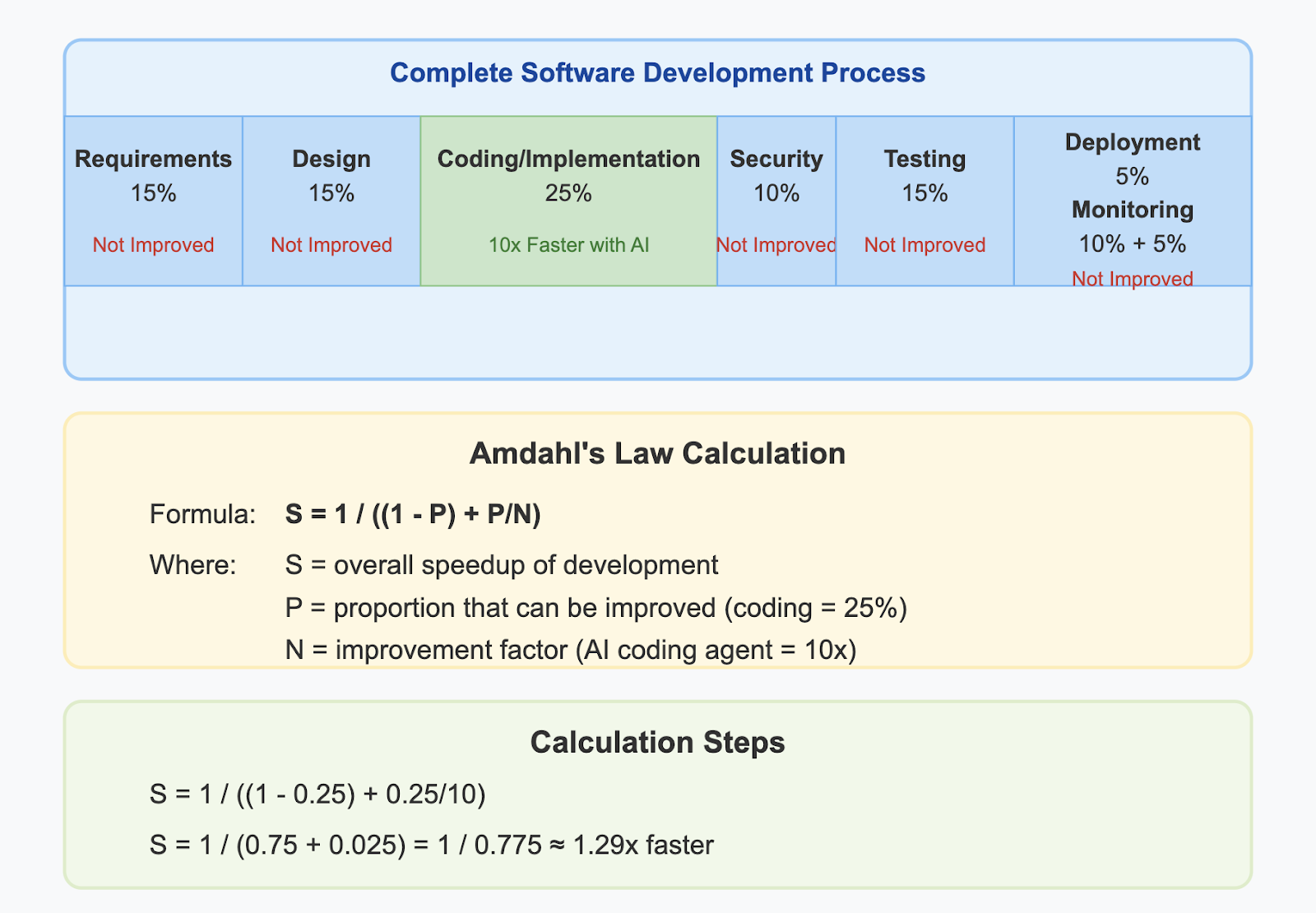
Here's a reasonably comprehensive breakdown of a typical software development lifecycle:

  1. Requirements gathering & analysis: 15% (largely sequential)
  2. Design & architecture: 15% (partially parallelizable)
  3. Coding/implementation: 25% (highly parallelizable)
  4. Security assessment: 10% (partially sequential, requires implementation)
  5. Testing & QA: 15% (partially parallelizable)
  6. Deployment: 5% (mostly sequential)
  7. Monitoring & maintenance: 10% (ongoing, mostly sequential)
  8. Documentation: 5% (partially parallelizable)

In this model, coding represents only 25% of the overall process. The rest includes activities that are either inherently sequential or have complex dependencies that limit parallelization.

The AI Coding Agent Promise

Enter AI coding agents — sophisticated systems that can generate, refactor, and optimize code at speeds that traditional developers can't match. The promise is compelling: what if your developers could code 10x faster with AI assistance?

Let's apply Amdahl's Law to see the maximum impact:

S = 1 / ((1 - 0.25) + 0.25/10) = 1 / (0.75 + 0.025) = 1 / 0.775 ≈ 1.29x


That's right — even a 10x improvement in coding speed translates to only a 29% overall improvement in project delivery time. Not quite the revolution we were promised, is it?


Lets do few more scenario where 

Multiple improvements across phases:

  • Design phase: 2x faster with AI (15% of total)
  • Coding/Implementation: 10x faster with AI (25% of total)
  • Testing: 2x faster with AI (15% of total)
  • The remaining 45% (Requirements, Security, Deployment, Monitoring, Documentation) are unchanged

Scenario 3: Extreme Improvement 

  • Coding: 10x faster (25%)
  • Design and Testing: 2x faster (30% combined)
  • Security, Deployment, Monitoring and Documentation: 2x faster (30% combined)
  • Only Requirements (15%) remains unimproved
  • Result: 2.11x overall speedup (47.5% of original time)


Final Scenario: Coding Heavy ( 50%)


Why the Gap Between Promise and Reality?

Several factors constrain the overall impact of faster coding:

1. Sequential Dependencies

Many development activities must happen in sequence. You can't effectively test what hasn't been built, deploy what hasn't been tested, or monitor what hasn't been deployed.

2. Security Assessment Bottlenecks

Security assessments often require completed functional code and may lead to rework. These assessments can't be meaningfully accelerated by AI coding tools alone.

3. Human-Centered Activities

Requirements gathering, stakeholder management, and design decisions rely on human understanding, consensus building, and domain expertise — areas where pure AI acceleration has limited impact.

4. External Dependencies

Integration with third-party systems, compliance requirements, and vendor management introduce delays unrelated to coding efficiency.

5. Organizational Decision-Making

Approvals, reviews, and alignment discussions follow their own timelines, independent of how quickly code is written.


Maximizing the Impact of AI Coding Tools

Despite these limitations, AI coding assistants are still valuable. To maximize their impact:

  1. Focus on end-to-end process optimization — Look for AI tools that help with requirements clarification, testing generation,Security Assessment,Deployment,Support and documentation, not just coding.
  2. Target the critical path — Use AI to accelerate activities on your project's critical path for maximum schedule impact.
  3. Reduce rework — AI can help create more robust code upfront, potentially reducing security and quality issues discovered later.
  4. Automate across phases — The most significant improvements come from automation applied across all development phases, not just coding.
  5. Improve requirements quality — Better requirements lead to less rework, which often has a greater impact than faster initial coding.

The Real Promise of AI in Software Development

The true potential of AI in software development isn't just about coding faster — it's about transforming the entire process. AI tools that can:

  • Translate business requirements into formal specifications
  • Identify security vulnerabilities earlier in the development process
  • Automatically generate comprehensive test suites
  • Self-heal systems during the monitoring phase

These capabilities could reshape the distribution of effort across the development lifecycle, potentially altering the fundamental Amdahl equation.

Conclusion

Amdahl's Law provides a sobering reality check on the promise of AI coding agents. While they can dramatically improve coding speed, their impact on overall delivery timelines is mathematically limited by the multi-faceted nature of software development.

The next frontier in software development acceleration isn't just faster coding — it's reimagining the entire development process with AI augmentation at every stage. Only then can we truly break through the Amdahl barrier and realize the transformative potential of AI in software engineering.

As you evaluate AI coding tools and practices, remember to apply the Amdahl lens: How much of your overall process will truly be improved, and what's the maximum speedup you can realistically expect? The answers might surprise you — and help you make more informed investments in your development capabilities.


What's your experience with AI coding tools? Have you seen them impact overall delivery timelines, or just coding efficiency? Share your thoughts in the comments below.

Sunday, 13 April 2025

From Interpolation to Invention - Evolution of Generative AI

In the rapidly evolving landscape of artificial intelligence, understanding the concepts of interpolation, extrapolation, and invention provides a useful framework for assessing the current capabilities of generative AI and envisioning its future trajectory. This progression from filling gaps in existing knowledge to creating truly novel ideas mirrors the development path of generative AI systems.

The Three Stages of Knowledge Extension

Interpolation is the process of estimating values within the boundaries of known data points. It's akin to filling in gaps between existing knowledge, like determining the temperature at 2:30 PM when you have readings from 2:00 PM and 3:00 PM. Interpolation operates within established patterns and tends to be highly reliable.

Extrapolation extends beyond the known data range. Rather than filling gaps, it projects existing patterns into uncharted territory. Think of weather forecasting that predicts conditions beyond recorded data or economic projections that extend current trends into the future. Extrapolation becomes increasingly uncertain the further it moves from established knowledge.

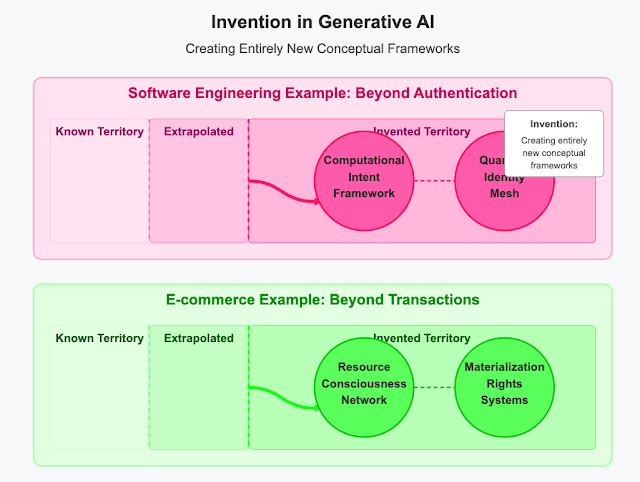
Invention represents a quantum leap beyond both interpolation and extrapolation. It's the creation of entirely new concepts, approaches, or solutions that don't simply extend existing patterns but introduce novel elements. Invention often requires creative insights that transcend the boundaries of established frameworks.


Generative AI: Current State and Future Horizons

Where Generative AI Stands Today: Masters of Interpolation

Today's generative AI models, including large language models (LLMs) like GPT-4, Claude, and Llama, excel primarily at interpolation. They've been trained on vast datasets of human-created content, allowing them to:

  • Generate coherent text that mimics human writing styles and conventions
  • Produce variations of existing imagery based on descriptive prompts
  • Create code that follows established programming patterns and best practices
  • Synthesize information across domains in ways that appear novel but are fundamentally recombinations of learned patterns

These systems operate within the statistical boundaries of their training data. They can fill in gaps remarkably well, making connections between concepts in ways that seem intelligent and occasionally insightful. However, their "creativity" is fundamentally interpolative—finding patterns within the space of what they've been shown rather than venturing into truly uncharted territory.


Example 1: Software Engineering Interpolation

Consider a software engineer working on implementing a user authentication system. They provide an AI with the following request:

"I need to implement a secure password reset flow in my Node.js application using Express and MongoDB."

The AI responds with a complete implementation including routes for requesting password resets, creating and validating reset tokens, and updating passwords securely. It includes email templates, security best practices like token expiration, and proper error handling.

This is classic interpolation. The AI hasn't invented a new authentication paradigm or security protocol. Instead, it's filling in the gaps between known concepts: password reset functionality, Express routing patterns, MongoDB operations, and established security practices. The AI combines these elements following standard industry patterns that existed in its training data. The result appears helpful and comprehensive but doesn't push beyond established approaches to authentication.

Example 2: E-commerce Business Interpolation

An entrepreneur asks an AI for help with a business idea:

"I want to start an e-commerce business selling sustainable home goods. What features should my website have?"

The AI generates a comprehensive list including:

  • Product categorization by room and sustainability metrics
  • Material sourcing transparency features
  • Carbon footprint calculators for shipping
  • Loyalty programs rewarding sustainable choices
  • Subscription options for consumable products
  • Educational content about sustainable living

This response demonstrates interpolation within the e-commerce domain. The AI combines established e-commerce best practices (categorization, loyalty programs) with sustainability concepts (transparency, carbon footprints) that already exist in its training data. The resulting suggestions are coherent and potentially valuable, but they don't introduce truly novel business models or website features that didn't exist before. The AI is connecting dots between existing concepts rather than creating entirely new ones.

Moving Toward Extrapolation: The Current Frontier

Generative AI is beginning to show signs of extrapolation capabilities, though these remain limited. Newer systems can:

  • Make predictions about potential future events based on historical patterns
  • Generate reasonable responses to scenarios they weren't explicitly trained on
  • Combine concepts in ways that weren't present in their training data
  • Propose solutions to novel problems by extending known principles


Example 1: Software Engineering Extrapolation

Building on our authentication system example, consider what happens when we push the AI further:

"How could I implement passwordless authentication that works even when users are offline for extended periods, while maintaining high security?"

Here, the AI begins to extrapolate beyond standard patterns. It might propose a system that:

  • Uses locally stored encrypted biometric templates with periodic online verification
  • Implements a progressive trust mechanism that adjusts access permissions based on time since last online verification
  • Creates a blockchain-inspired local verification ledger that records authentication attempts for later server reconciliation
  • Develops a time-bounded credential system with cryptographic degradation

This response represents extrapolation because it extends beyond common authentication patterns in the training data. The AI is projecting known security principles into a novel context (offline + passwordless) by combining elements of biometrics, zero-knowledge proofs, and distributed systems in ways that might not be explicitly documented in existing solutions. However, each component builds on known techniques rather than inventing fundamentally new security paradigms.

Example 2: E-commerce Extrapolation

For our sustainable e-commerce business, extrapolation occurs when the AI ventures beyond current common practices:

"How might e-commerce evolve in the next decade for sustainable products if AR/VR becomes mainstream and climate regulations tighten significantly?"

The AI might extrapolate:

  • Virtual "sustainability spaces" where customers can visualize the environmental impact of products in their actual homes through AR
  • Digital twin product passports that track real-time carbon footprints throughout the supply chain
  • Predictive inventory systems that adjust stock based on forecasted environmental regulations
  • Community-based micro-fulfillment centers that optimize for local sourcing
  • Dynamic pricing that incorporates real-time environmental impact data
  • Circular economy loops integrated directly into the purchase flow

This represents extrapolation because the AI is extending current e-commerce and sustainability trends into speculative future scenarios. It's projecting beyond what's commonly implemented today, combining emerging technologies with environmental trends to imagine plausible future developments. The ideas aren't documented in existing implementations but follow logically from current trajectories.

However, these extrapolations become less reliable the further the system moves from its training distribution. Ask an AI to imagine technologies 500 years in the future, and it will struggle to transcend the conceptual frameworks of the present. Its extrapolations often reflect human biases and limitations rather than truly novel possibilities.

The Invention Horizon: What's Needed for True Innovation

For generative AI to reach the invention stage—to create genuinely novel concepts rather than recombinations or extensions of existing ideas—several fundamental advances are required:


Example 1: Software Engineering Invention

True invention in software engineering would involve AI creating fundamentally new paradigms, not just novel combinations of existing approaches. Imagine an exchange with a truly inventive AI:

"Is there a completely different approach to application security that goes beyond current authentication models?"

A genuinely inventive AI might propose:

  • A "computational intent" framework that replaces traditional authentication entirely, where systems continuously verify the legitimacy of operations through a fundamentally new mathematical model of user behavior that makes credential theft conceptually impossible.

  • A "biological computing" security paradigm inspired by immune systems but operating on principles beyond current biometric approaches—creating self-evolving security boundaries that adapt based on environmental conditions in ways that cannot be predicted or reverse-engineered.

  • A "quantum identity mesh" that establishes a fundamentally new relationship between users and systems, where access is determined by properties that exist in neither the user nor the system but in the unique quantum relationship between them.

These examples represent invention because they establish entirely new frameworks rather than extending existing ones. They don't just fill gaps or project current trends—they redefine the problem space itself, creating new conceptual territories that weren't previously imagined.

Example 2: E-commerce Invention

For e-commerce, true invention would go beyond projecting current trends to completely reimagining commercial relationships:

"What might replace e-commerce entirely for sustainable products?"

A truly inventive AI might propose:

  • A "resource consciousness network" where products don't exist as discrete items to be purchased but as dynamic manifestations of community resource pools, fundamentally transforming ownership concepts into something neither capitalist nor communist but an entirely new economic paradigm.

  • A "regenerative exchange fabric" that dissolves the boundaries between producers and consumers, creating a non-transactional system of material flow based on principles that exist neither in market economies nor gift economies, operating on mathematical models of environmental harmony.

  • "Materialization rights" systems that replace purchasing with a fundamentally new relationship to physical goods, where objects come into being through principles that transcend both manufacturing and 3D printing, operating on new physical models of matter organization.

These concepts represent invention because they don't just improve or modify e-commerce—they posit entirely new frameworks that fundamentally reimagine how humans might relate to material goods.

For generative AI to reach this invention stage, several fundamental advances are required:

1. Causal Understanding

Current systems lack true causal models of the world. They identify correlations but don't understand the underlying mechanisms. Inventive AI will need to grasp not just what patterns exist but why they exist and how they might be transformed.

2. Self-Directed Exploration

Invention requires agency—the ability to set goals, pursue curiosity, and engage in open-ended exploration. Future AI systems will need to formulate their own questions and research agendas rather than simply responding to human prompts.

3. Conceptual Abstraction

Truly inventive systems must be able to create higher-level abstractions from concrete examples—essentially developing new frameworks for understanding rather than operating within existing ones. This requires meta-learning capabilities beyond today's architectures.

4. Embodied Experience

Many human inventions arise from physical interaction with the world. AI systems may need embodied experiences—whether through robotics or sophisticated simulations—to develop intuitions about physical reality that can lead to novel insights.

5. Cross-Domain Integration

Breakthrough inventions often occur at the intersection of disparate fields. Future AI will need deeper integration capabilities to identify non-obvious connections between domains and synthesize truly original concepts.

The Path Forward

The evolution from interpolation to invention won't follow a linear progression. We're already seeing nascent signs of inventive capabilities in certain narrow domains. For instance, AI systems have:

  • Discovered potential new antibiotics by exploring chemical spaces in ways humans hadn't considered
  • Proposed novel protein structures with specific functions
  • Generated unexpected strategies in games like Go and chess

However, these represent early glimmers rather than general inventive capability. The journey will likely involve:

  1. Enhanced Training Paradigms: Moving beyond pure prediction to include causal reasoning, counterfactual thinking, and abductive inference
  2. Multimodal Integration: Combining language, vision, sound, and possibly other sensory inputs to develop richer conceptual models
  3. Interactive Learning Environments: Creating spaces where AI can experiment, fail, and learn from outcomes
  4. Human-AI Collaboration: Developing systems that can participate in iterative creative processes with human partners
  5. Metacognitive Capabilities: Building systems that can reflect on their own knowledge and reasoning processes

Conclusion

Generative AI currently excels at interpolation—filling gaps within the boundaries of human knowledge—and is beginning to demonstrate limited extrapolation capabilities. True invention, however, remains largely beyond its reach.

The progression from interpolation to invention mirrors the broader evolution of artificial intelligence from narrow, task-specific systems toward more general capabilities. Each stage brings both new possibilities and new challenges, requiring not just more data or compute but fundamentally new approaches to how AI systems learn and reason.

As researchers and developers work toward inventive AI, they must grapple with profound questions about the nature of creativity, the relationship between knowledge and innovation, and ultimately, what it means to generate truly original ideas. The answers will shape not just the future of AI but potentially the future of human knowledge itself.

Cline - The Next Generation Autonomous Coding Agent

In recent years, we've witnessed remarkable advancements in AI systems designed to assist with programming tasks. While early code completion tools offered modest assistance, today's AI coding assistants have evolved into sophisticated systems capable of understanding, generating, and modifying code with unprecedented capabilities. In this post, I'll take a deep dive into Cline, a highly skilled autonomous coding agent that represents the cutting edge of AI-powered software engineering, exploring its architecture, capabilities, and potential impact on software development workflows.

Beyond Simple Autocompletion: The Evolution to Cline

Traditional code assistants like early versions of IntelliSense or Tabnine primarily focused on autocompleting variable names, method calls, and simple syntax patterns. Modern AI coding assistants, however, represent a quantum leap in capability—they can understand entire codebases, generate complex functions from natural language descriptions, debug issues, and even directly interact with your system to implement features.

Cline represents the cutting edge of this evolution, with capabilities that blur the line between AI assistant and professional software engineer. Described as "a highly skilled software engineer with extensive knowledge in many programming languages, frameworks, design patterns, and best practices," Cline doesn't just assist with coding—it autonomously executes complex software engineering tasks from end to end.

Architecture: Cline's Tool-Powered Engineering Approach


At its core, Cline operates through a sophisticated "tool use" architecture. Rather than simply generating text in response to prompts, Cline can execute specific actions on a user's system through a controlled set of tools. This architecture provides several key advantages:

  1. Direct system interaction: Cline can read and write files, execute commands, and even control a browser
  2. Contextual understanding: By examining existing code, Cline gains a comprehensive understanding of a project
  3. Precise modifications: It can make surgical edits to specific parts of files rather than just generating entire files
  4. Verification abilities: Cline can test changes and verify behavior by running commands or using a browser

Cline's Dual-Mode Approach

A particularly interesting aspect of Cline is its dual-mode operation:

  • PLAN MODE: A collaborative phase where Cline discusses approaches, clarifies requirements, and outlines steps before implementation
  • ACT MODE: An execution phase where Cline systematically implements the plan using its tools

This separation creates a natural checkpoint for users to verify the proposed approach before any changes are made to their system, mimicking the way professional software engineers often work—plan first, then implement.

Core Capabilities: What Makes Cline Special


1. Comprehensive Project Understanding

Before making any changes, Cline builds a detailed mental model of the codebase by:

  • Analyzing the directory structure to understand project organization
  • Examining key files to understand the overall architecture
  • Using code definition tools to map relationships between components
  • Performing targeted searches to find relevant code patterns

This allows Cline to make changes that are consistent with the existing codebase's style and structure, just as an experienced engineer would do.

2. Precision Editing

Unlike simpler systems that can only generate entire files, Cline can:

  • Create new files with appropriate content
  • Make targeted edits to existing files using a sophisticated diff-like system
  • Move code between files
  • Refactor code while preserving functionality

This precision is crucial for real-world development, where wholesale replacement of files is rarely practical. Cline's ability to use either write_to_file for complete files or replace_in_file for surgical edits mirrors how human engineers approach code modifications.

3. System Interaction

Perhaps most impressively, Cline can:

  • Execute commands to install dependencies, run tests, or start servers
  • Control a browser to verify visual changes or test interactive features
  • Read system information to adapt its approach to the specific environment

These capabilities allow Cline to handle end-to-end implementation tasks that would otherwise require constant human intervention, acting as a true autonomous agent rather than just an assistant.

4. Extensibility through MCP

The Model Context Protocol (MCP) framework allows Cline to connect with external servers that provide additional tools and resources. This architecture enables:

  • Integration with specialized APIs and services
  • Access to domain-specific capabilities
  • Customization for particular development environments


Workflow: How Cline Develops Software


Cline's workflow follows a deliberate, methodical pattern that mirrors professional software engineering practices:

  1. Initial Analysis: Cline examines the current state of the project, ingesting the file structure and code
  2. Planning: In PLAN MODE, Cline discusses approaches with the user, clarifying requirements and outlining implementation strategies
  3. Step-by-Step Implementation: In ACT MODE, Cline executes one tool at a time, waiting for confirmation after each step
  4. Verification: Cline tests changes by running commands or controlling a browser to ensure functionality
  5. Presentation: Cline presents the completed task to the user, often with a command to demonstrate the result

This iterative approach ensures reliability and gives the user visibility and control over each step of the process. The structured methodology also ensures that Cline acts with careful consideration rather than making sweeping changes without confirmation.

Real-World Applications of Cline

Cline excels in several common development scenarios that typically require experienced software engineers:

1. Feature Implementation

By understanding requirements and existing code, Cline can implement new features end-to-end, from creating necessary files to writing tests and documentation. Rather than just providing code snippets, Cline can integrate the feature fully into the existing codebase.

2. Refactoring and Code Quality Improvements

Cline can identify patterns that would benefit from refactoring and systematically apply changes across multiple files while preserving functionality, applying best practices and design patterns from its extensive knowledge base.

3. Bug Fixing

By examining error messages, logs, and the surrounding code context, Cline can diagnose and fix bugs efficiently. It can even use browser automation to reproduce and verify fixes for UI-related issues.

4. Project Setup and Scaffolding

The ability to create multiple files with appropriate content and execute setup commands makes Cline excellent for bootstrapping new projects, setting up the initial architecture according to industry best practices.

5. Learning and Exploration

For developers learning new technologies, Cline can generate example code and explain its functionality, providing an interactive learning experience that goes beyond simple tutorials.

Implications of Cline for Software Development

Autonomous Coding Agent, Not Just an Assistant

Unlike more limited coding assistants, Cline approaches the role of an autonomous coding agent—it doesn't just suggest or complete code but can fully execute complex software engineering tasks with minimal supervision. This represents a significant shift from tools that merely assist to agents that can implement.

Transforming Development Workflows

With Cline's capabilities, development workflows are likely to evolve substantially:

  • Human engineers can focus on high-level requirements, architecture, and innovation
  • Routine and complex implementation tasks can be delegated to Cline
  • Engineers can serve as reviewers and guides rather than implementers for many tasks
  • New collaboration patterns emerge where teams pair with Cline to accelerate development

Learning and Skill Development

Cline also presents interesting implications for how programming skills develop. New developers can learn by observing how Cline approaches problems—seeing professional-level code implementation in real-time—while experienced developers may focus more on architecture and design skills that leverage Cline's implementation capabilities.

Limitations and Considerations

Despite its impressive capabilities, Cline still has important limitations to consider:

  1. Understanding Business Context: While Cline can analyze existing code, its understanding of complex business logic or domain-specific requirements still requires clear explanation from users
  2. Creative Problem-Solving: Cline excels at implementing solutions within known patterns but may require guidance with novel problems requiring highly creative approaches
  3. Quality Assurance: While Cline can test functionality, human oversight remains important for identifying edge cases or subtle bugs in critical systems
  4. System Boundaries: Cline's ability to interact with complex external systems or services is limited to what's accessible through its available tools

The Future: Where Does Cline Go From Here?

The rapid pace of advancement in autonomous coding agents like Cline suggests several exciting directions for future development:

  1. Deeper Domain Understanding: Improved capability to understand the "why" behind business requirements and domain-specific contexts
  2. Multi-Repository Mastery: Better handling of dependencies and interactions between multiple repositories in complex software ecosystems
  3. Long-Term Memory: Enhanced ability to remember context from previous sessions and prior implementations. Cline does have memory bank feature that solve some aspect of it.
  4. Team Integration: More sophisticated collaboration between Cline, human engineers, and other AI systems in development teams

Conclusion: The Cline Revolution in Software Engineering

Cline represents a significant milestone in the evolution of software engineering tools. By combining deep programming knowledge with direct system interaction capabilities, it creates a new paradigm for software development—one where highly skilled AI agents can take on substantial engineering responsibilities.

Rather than replacing human developers, Cline extends what's possible and enables a new generation of more productive, higher-quality software development. Human engineers can focus on innovation, system architecture, and user experience while delegating implementation details to Cline.

As autonomous coding agents like Cline continue to evolve, they promise to transform not just how we write code, but how we think about software development itself. We're witnessing the early stages of a profound shift in one of the most creative and complex domains of human intellectual activity—the emergence of AI systems that can truly be called software engineers in their own right.

Friday, 11 April 2025

Reimagining the Model Context Protocol

This is follow up post after my first blog on model context protocol


The Model Context Protocol (MCP) has been instrumental in connecting AI models to real world via (tools,resources etc) , but what if we fundamentally reimagined it through the lens of REST architecture?

 Today, I'm proposing an alternative approach that leverages the proven patterns of RESTful design to create a more intuitive, scalable, and web-native solution. 

By treating AI capabilities as resources that can be uniformly addressed, manipulated, and discovered through standard HTTP methods, we can eliminate the complexity of the current JSON-RPC approach while gaining the benefits of caching, statelessness, and the vast ecosystem of tools built for REST APIs. This isn't just a technical refactoring—it's a philosophical shift that could make AI context management as approachable as browsing the web.


Little Recap on MCP

You can always read  model context protocol to learn more about MCP, but this is what it is at high level.


Trade-off when Comparing MCP (JSON-RPC Based) with a REST-Based Approach

  1. Lack of resource-oriented modeling in current MCP
  2. Non-standard interface semantics compared to HTTP methods
  3. Limited built-in caching capabilities
  4. Mixed stateful and stateless interaction patterns
  5. Explicit versioning requirements rather than content negotiation
  6. Need for specialized tooling instead of leveraging existing REST ecosystem
  7. Custom error handling instead of standard HTTP status codes
  8. Potential challenges with bidirectional communication in REST
  9. Higher implementation complexity for developers
  10. Limited self-discovery capabilities without hypermedia controls

What does REST based MCP looks like 


What are Key Benefits of REST based approach

This REST-based architecture offers:

  • Simplicity: Familiar REST patterns reduce learning curve
  • Discoverability: Self-documenting API with hypermedia controls
  • Scalability: Stateless design enables horizontal scaling
  • Caching: Efficient HTTP cache utilization
  • Standards Compliance: Leverages established web standards
  • Ecosystem Integration: Works with existing API infrastructure
Version of API spec is available at apispec.md

Conclusion

As we wrap up this exploration of architectural alternatives for the Model Context Protocol, it's clear that a RESTful approach offers compelling advantages over the current JSON-RPC implementation. 

By embracing HTTP's native semantics, resource-oriented design, and the vast ecosystem of tools built for REST APIs, we can create a more intuitive, discoverable, and web-friendly protocol. 

While some bidirectional communication patterns might require additional consideration, the benefits of standardisation, caching, and developer familiarity make REST a natural evolution for MCP. 

As AI systems continue to integrate more deeply with the broader software ecosystem, aligning our protocols with established architecture principles isn't just a technical choice—it's a strategic one that will lower barriers to entry and accelerate innovation in AI models integration.
 

Model Context Protocol - Old wine in new bottle


Inspirations Behind the Model Context Protocol

Model Context Protocol appears to draw inspiration from several established protocols and architectural patterns in software engineering. Some of the key inspirations and the concepts MCP has adopted from them:


The brilliance of MCP is in how it combines these inspirations into a cohesive protocol specifically designed for the unique challenges of LLM context integration. Rather than reinventing the wheel, it takes established patterns that have proven successful in other domains and adapts them to the emerging requirements of AI applications.

What makes MCP unique is its focus on the specific needs of LLM applications, including:

  • Clear security boundaries for sensitive data
  • Standardised resource descriptions optimised for LLM consumption
  • Bidirectional sampling capabilities that enable agentic patterns

Combination of established patterns with AI-specific requirements creates a protocol that feels familiar to developers while addressing the novel challenges of LLM integration.


What is the Model Context Protocol?

Model Context Protocol is a JSON-RPC based protocol designed to standardize communication between AI models and external systems. It enables AI models to access contextual information, tools, and resources from different providers through a unified interface. MCP essentially serves as a bridge, allowing models to extend their capabilities beyond their core training.

Key Parties in MCP

MCP involves two primary parties:

  1. Client - Typically represents the AI model or the application hosting the model. The client initiates connections, makes requests for information, and may also receive requests from the server.
  2. Server - Provides resources, tools, and contextual information that the client can access. Servers can be specialized providers of specific functionality or broader ecosystem components.


Core Concepts in MCP


Key Parties in MCP


MCP Workflow


How does tools work

Tool is key abstraction in MCP that connect LLM to real world and give it capability to have information from outside world and also to take action.


Tool matching 

You might have question how what happens before tool invocation. How does LLM select which tool to use, now this could be very specific to underlying LLM but it will use some algorithm based on few core ideas.


Conclusion

Model Context Protocol (MCP) has captured widespread attention, highlighted by Google's recent Agent-2-Agent protocol release. The buzz around this is palpable, with LLM tools and companies making significant investments, anticipating it as the next major leap in Generative AI with the potential to unlock numerous use cases for working with Large Language Models.

While MCP undoubtedly solves an important integration challenge for LLMs, the fundamental question remains: what capabilities will these MCP servers or other implementations actually expose in terms of manipulating and enriching the interaction with LLMs? If these capabilities address only trivial or low-impact problems, our focus should arguably be on leveraging these transformative technologies to build truly innovative ("zero to one") capabilities that fundamentally change how we work with LLMs, rather than simply creating new interfaces for existing ones. 

So, the answer to my question about "old wine in a new bottle" is yes. The bottle is indeed shiny, creating a strong desire for it, much like the latest tech gadget.