Showing posts with label Coding Agent. Show all posts

Friday, 30 May 2025

RAG vs Non-RAG Coding Agents

Every time a developer asks an AI coding assistant to generate code, they're initiating a search process. But the question isn't whether search happens—it's where and how that search occurs. Search can be done in model knowledge base or it can use some tools to perform search.

Code Is Different - but why ?

Searching for code is interesting search problem and it has it unique challenges.

When a human programmer approaches a codebase, they don't just look for similar examples. They build a mental model of how the system works: - How data flows through the application - What architectural patterns are being used - How different modules interact and depend on each other - What the implicit contracts and assumptions are This mental model is what enables programmers to make changes without breaking the system, debug complex issues, and extend functionality in coherent ways.


What are options for code search algorithms


Retrieval Augmentation Generation (RAG)


RAG excels at finding relevant information and synthesizing it into coherent responses. This works brilliantly for answering questions about historical facts or summarizing documents. But code isn't documentation—it's a living system of interconnected logic that demands deep understanding.

- The Precision Problem: When "Close Enough" Breaks Everything


RAG, operates on surface-level similarity. It retrieves code snippets that look relevant but may operate under completely different assumptions about data structures, error handling patterns, or architectural constraints.

In most applications, RAG's precision-recall trade-off is manageable. If a chatbot gives you 90% accurate information, that's often good enough. But code demands near-perfect precision. A single misplaced bracket, incorrect variable name, or wrong assumption about data types can crash entire systems or bad user experience as code will be rejected. RAG optimizes for semantic similarity, not functional correctness. It might retrieve code that's conceptually similar but functionally incompatible:
- A function that looks right but expects different parameter types - Error handling patterns that don't match the codebase's conventions - Solutions that work in one context but fail in another due to different dependencies This isn't just an inconvenience—it's a fundamental mismatch between what RAG provides and what coding requires.

The Context Catastrophe

Code exists in rich, interconnected contexts that span multiple files, modules, and even repositories. A seemingly simple function might depend on: - Configuration files that define system behavior - Environment variables that change at runtime - Database schemas that constrain data operations - Architectural patterns that dictate how modules interact RAG retrieves chunks of information based on similarity, but coding decisions often depend on distant context that's impossible to capture in isolated snippets. The system might retrieve the perfect function implementation, but it's designed for a completely different architectural context.

- The Dynamic System Challenge

Perhaps most critically, effective coding requires real-time interaction with living systems. Coding is fundamentally about: - Writing code and seeing how it behaves - Running tests to validate assumptions - Using compiler errors as feedback - Debugging by tracing execution paths - Iterating based on runtime behavior RAG provides static information about how someone else solved a similar problem. But what you need is dynamic interaction with your current, specific codebase.

Reasoning Retrieval Generation (RRG)

RRG is new term that i am going to use for Reasoning based approach.

Lets look into what happens in RRG based approach and it can also be called Reasoning first approach.

In reasoning first approach , chain of thought , self reflection , Tree of Thought etc becomes primary tool. Lets look at how does this thing works 


- Build Mental Models in Real-Time

Instead of retrieving similar code, reasoning-based agents analyze the actual codebase to understand: - How the system is structured and why - What patterns and conventions are being followed - How data flows through different components - What the implicit contracts and assumptions are

- Leverage Tool Integration

Rather than retrieving documentation, effective coding agents interact directly with development tools: - Compilers and interpreters for immediate feedback - Testing frameworks to validate solutions - Debuggers to trace execution and find issues - Static analysis tools to understand code structure - Version control systems to understand change history

- Think Through Problems Step-by-Step

Chain of thought reasoning allows agents to: - Trace through code execution paths to understand behavior - Identify root causes of bugs through logical deduction - Reason about the implications of changes before making them - Build solutions from first principles rather than pattern matching

Trade-Off - Aspect that you can't ignore

Nothing comes for free , lets look at tradeoff of RRG

Knowledge Boundaries

RRG agents are limited by their training data. They can't access: - Documentation for recently released libraries - Community solutions to novel problems - Project-specific conventions not captured in code - Specialized domain knowledge from external sources But here's the key insight:

Understanding trumps information access.
A solid mental model of how systems work doesn't become outdated when new frameworks are released. The fundamentals of good design, debugging approaches, and architectural thinking remain stable across technology changes.


Context Window Constraints

Without retrieval, agents must work within their context limits. Large codebases can exceed what fits in memory. However, this constraint forces better architectural approaches: - Focus on understanding system structure and patterns - Use tool integration to navigate codebases systematically - Build summarization and abstraction capabilities - Develop better code analysis and navigation strategies

Specialized Domain Gaps

RRG agents may struggle with highly specialized domains not well-represented in training data. But this is where tool integration shines—rather than retrieving domain knowledge, agents can interact with domain-specific tools and APIs directly.


Cost and Resources Challenges

Needs large context models ( 100K+ or 1M)
High per request cost due to massive context usage
Not Cost optimised.
Slow inference due to processing of entire context
Instruction following limitation by LLM as context gets close to 50% fill.

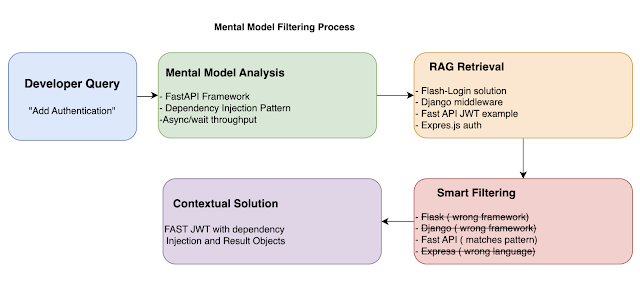
What is solution - best of both world


Fusion is solution.

Mental Model Filtering Process


The battle for dominance in the coding agent landscape is heating up. Will the winner be IDE-integrated solutions like Cursor, Windsurf, VS Code, or IntelliJ? Perhaps it will be Claude Code or Openai-codex or google jules ? Or could the no-code and low-code platforms like Bolt, Loveable, Replit or Open source like Aider, or Cline ultimately ?

But here's the twist: while these coding agents compete fiercely for market share, someone else is already winning this game—and the answer might be more obvious than you think.

Monday, 21 April 2025

Amdahl's Law and the Myth of 10x Developers in the AI Age

 In the rapidly evolving landscape of software development, we're witnessing a surge in AI coding assistants and the eternal pursuit of the "10x developer" — those mythical engineers who can produce ten times more than their peers. But what if I told you that even with AI-powered coding agents, the fundamental laws of project speedup remain unchanged? Let's explore how Amdahl's Law puts a hard ceiling on just how much faster your features can actually be delivered.

Understanding Amdahl's Law


First formulated by computer architect Gene Amdahl in 1967, Amdahl's Law is a formula that helps predict the theoretical maximum speedup of a system when only part of it is improved. It's elegantly simple:

S = 1 / ((1 - P) + P/N)

Where:

  • S is the theoretical speedup of the entire task
  • P is the proportion of the task that can be parallelized or improved
  • N is the improvement factor (how many times faster the improved portion becomes)
  • (1 - P) represents the portion that remains unimproved

This formula reveals a critical insight: even infinite improvement in one part of a process yields limited overall improvement if other parts remain unchanged.

Let's illustrate with a simple example: If 60% of a system can be parallelized, and we throw infinite resources at it (N → ∞), the maximum speedup possible is:

S = 1 / (1 - 0.6) = 1 / 0.4 = 2.5x

No matter how many processors, no matter how much parallelization — we can never exceed 2.5x improvement. This is the "Amdahl barrier."

Software Development Through the Amdahl Lens

Now, let's apply this principle to software development. The creation of software isn't just about writing code — it's a complex, multi-stage process with inherent dependencies.

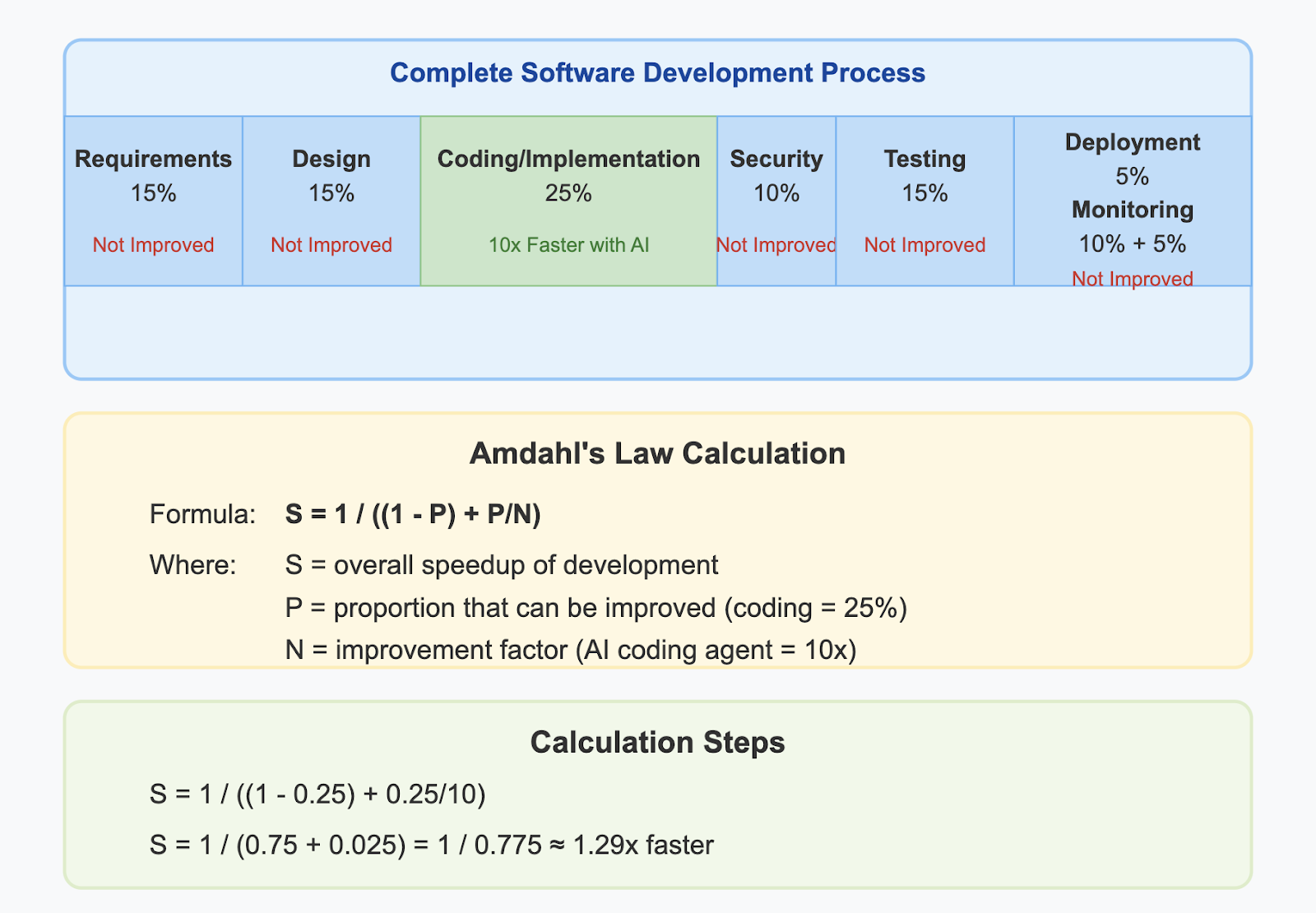
Here's a reasonably comprehensive breakdown of a typical software development lifecycle:

  1. Requirements gathering & analysis: 15% (largely sequential)
  2. Design & architecture: 15% (partially parallelizable)
  3. Coding/implementation: 25% (highly parallelizable)
  4. Security assessment: 10% (partially sequential, requires implementation)
  5. Testing & QA: 15% (partially parallelizable)
  6. Deployment: 5% (mostly sequential)
  7. Monitoring & maintenance: 10% (ongoing, mostly sequential)
  8. Documentation: 5% (partially parallelizable)

In this model, coding represents only 25% of the overall process. The rest includes activities that are either inherently sequential or have complex dependencies that limit parallelization.

The AI Coding Agent Promise

Enter AI coding agents — sophisticated systems that can generate, refactor, and optimize code at speeds that traditional developers can't match. The promise is compelling: what if your developers could code 10x faster with AI assistance?

Let's apply Amdahl's Law to see the maximum impact:

S = 1 / ((1 - 0.25) + 0.25/10) = 1 / (0.75 + 0.025) = 1 / 0.775 ≈ 1.29x


That's right — even a 10x improvement in coding speed translates to only a 29% overall improvement in project delivery time. Not quite the revolution we were promised, is it?


Lets do few more scenario where 

Multiple improvements across phases:

  • Design phase: 2x faster with AI (15% of total)
  • Coding/Implementation: 10x faster with AI (25% of total)
  • Testing: 2x faster with AI (15% of total)
  • The remaining 45% (Requirements, Security, Deployment, Monitoring, Documentation) are unchanged

Scenario 3: Extreme Improvement 

  • Coding: 10x faster (25%)
  • Design and Testing: 2x faster (30% combined)
  • Security, Deployment, Monitoring and Documentation: 2x faster (30% combined)
  • Only Requirements (15%) remains unimproved
  • Result: 2.11x overall speedup (47.5% of original time)


Final Scenario: Coding Heavy ( 50%)


Why the Gap Between Promise and Reality?

Several factors constrain the overall impact of faster coding:

1. Sequential Dependencies

Many development activities must happen in sequence. You can't effectively test what hasn't been built, deploy what hasn't been tested, or monitor what hasn't been deployed.

2. Security Assessment Bottlenecks

Security assessments often require completed functional code and may lead to rework. These assessments can't be meaningfully accelerated by AI coding tools alone.

3. Human-Centered Activities

Requirements gathering, stakeholder management, and design decisions rely on human understanding, consensus building, and domain expertise — areas where pure AI acceleration has limited impact.

4. External Dependencies

Integration with third-party systems, compliance requirements, and vendor management introduce delays unrelated to coding efficiency.

5. Organizational Decision-Making

Approvals, reviews, and alignment discussions follow their own timelines, independent of how quickly code is written.


Maximizing the Impact of AI Coding Tools

Despite these limitations, AI coding assistants are still valuable. To maximize their impact:

  1. Focus on end-to-end process optimization — Look for AI tools that help with requirements clarification, testing generation,Security Assessment,Deployment,Support and documentation, not just coding.
  2. Target the critical path — Use AI to accelerate activities on your project's critical path for maximum schedule impact.
  3. Reduce rework — AI can help create more robust code upfront, potentially reducing security and quality issues discovered later.
  4. Automate across phases — The most significant improvements come from automation applied across all development phases, not just coding.
  5. Improve requirements quality — Better requirements lead to less rework, which often has a greater impact than faster initial coding.

The Real Promise of AI in Software Development

The true potential of AI in software development isn't just about coding faster — it's about transforming the entire process. AI tools that can:

  • Translate business requirements into formal specifications
  • Identify security vulnerabilities earlier in the development process
  • Automatically generate comprehensive test suites
  • Self-heal systems during the monitoring phase

These capabilities could reshape the distribution of effort across the development lifecycle, potentially altering the fundamental Amdahl equation.

Conclusion

Amdahl's Law provides a sobering reality check on the promise of AI coding agents. While they can dramatically improve coding speed, their impact on overall delivery timelines is mathematically limited by the multi-faceted nature of software development.

The next frontier in software development acceleration isn't just faster coding — it's reimagining the entire development process with AI augmentation at every stage. Only then can we truly break through the Amdahl barrier and realize the transformative potential of AI in software engineering.

As you evaluate AI coding tools and practices, remember to apply the Amdahl lens: How much of your overall process will truly be improved, and what's the maximum speedup you can realistically expect? The answers might surprise you — and help you make more informed investments in your development capabilities.


What's your experience with AI coding tools? Have you seen them impact overall delivery timelines, or just coding efficiency? Share your thoughts in the comments below.

Sunday, 13 April 2025

Cline - The Next Generation Autonomous Coding Agent

In recent years, we've witnessed remarkable advancements in AI systems designed to assist with programming tasks. While early code completion tools offered modest assistance, today's AI coding assistants have evolved into sophisticated systems capable of understanding, generating, and modifying code with unprecedented capabilities. In this post, I'll take a deep dive into Cline, a highly skilled autonomous coding agent that represents the cutting edge of AI-powered software engineering, exploring its architecture, capabilities, and potential impact on software development workflows.

Beyond Simple Autocompletion: The Evolution to Cline

Traditional code assistants like early versions of IntelliSense or Tabnine primarily focused on autocompleting variable names, method calls, and simple syntax patterns. Modern AI coding assistants, however, represent a quantum leap in capability—they can understand entire codebases, generate complex functions from natural language descriptions, debug issues, and even directly interact with your system to implement features.

Cline represents the cutting edge of this evolution, with capabilities that blur the line between AI assistant and professional software engineer. Described as "a highly skilled software engineer with extensive knowledge in many programming languages, frameworks, design patterns, and best practices," Cline doesn't just assist with coding—it autonomously executes complex software engineering tasks from end to end.

Architecture: Cline's Tool-Powered Engineering Approach


At its core, Cline operates through a sophisticated "tool use" architecture. Rather than simply generating text in response to prompts, Cline can execute specific actions on a user's system through a controlled set of tools. This architecture provides several key advantages:

  1. Direct system interaction: Cline can read and write files, execute commands, and even control a browser
  2. Contextual understanding: By examining existing code, Cline gains a comprehensive understanding of a project
  3. Precise modifications: It can make surgical edits to specific parts of files rather than just generating entire files
  4. Verification abilities: Cline can test changes and verify behavior by running commands or using a browser

Cline's Dual-Mode Approach

A particularly interesting aspect of Cline is its dual-mode operation:

  • PLAN MODE: A collaborative phase where Cline discusses approaches, clarifies requirements, and outlines steps before implementation
  • ACT MODE: An execution phase where Cline systematically implements the plan using its tools

This separation creates a natural checkpoint for users to verify the proposed approach before any changes are made to their system, mimicking the way professional software engineers often work—plan first, then implement.

Core Capabilities: What Makes Cline Special


1. Comprehensive Project Understanding

Before making any changes, Cline builds a detailed mental model of the codebase by:

  • Analyzing the directory structure to understand project organization
  • Examining key files to understand the overall architecture
  • Using code definition tools to map relationships between components
  • Performing targeted searches to find relevant code patterns

This allows Cline to make changes that are consistent with the existing codebase's style and structure, just as an experienced engineer would do.

2. Precision Editing

Unlike simpler systems that can only generate entire files, Cline can:

  • Create new files with appropriate content
  • Make targeted edits to existing files using a sophisticated diff-like system
  • Move code between files
  • Refactor code while preserving functionality

This precision is crucial for real-world development, where wholesale replacement of files is rarely practical. Cline's ability to use either write_to_file for complete files or replace_in_file for surgical edits mirrors how human engineers approach code modifications.

3. System Interaction

Perhaps most impressively, Cline can:

  • Execute commands to install dependencies, run tests, or start servers
  • Control a browser to verify visual changes or test interactive features
  • Read system information to adapt its approach to the specific environment

These capabilities allow Cline to handle end-to-end implementation tasks that would otherwise require constant human intervention, acting as a true autonomous agent rather than just an assistant.

4. Extensibility through MCP

The Model Context Protocol (MCP) framework allows Cline to connect with external servers that provide additional tools and resources. This architecture enables:

  • Integration with specialized APIs and services
  • Access to domain-specific capabilities
  • Customization for particular development environments


Workflow: How Cline Develops Software


Cline's workflow follows a deliberate, methodical pattern that mirrors professional software engineering practices:

  1. Initial Analysis: Cline examines the current state of the project, ingesting the file structure and code
  2. Planning: In PLAN MODE, Cline discusses approaches with the user, clarifying requirements and outlining implementation strategies
  3. Step-by-Step Implementation: In ACT MODE, Cline executes one tool at a time, waiting for confirmation after each step
  4. Verification: Cline tests changes by running commands or controlling a browser to ensure functionality
  5. Presentation: Cline presents the completed task to the user, often with a command to demonstrate the result

This iterative approach ensures reliability and gives the user visibility and control over each step of the process. The structured methodology also ensures that Cline acts with careful consideration rather than making sweeping changes without confirmation.

Real-World Applications of Cline

Cline excels in several common development scenarios that typically require experienced software engineers:

1. Feature Implementation

By understanding requirements and existing code, Cline can implement new features end-to-end, from creating necessary files to writing tests and documentation. Rather than just providing code snippets, Cline can integrate the feature fully into the existing codebase.

2. Refactoring and Code Quality Improvements

Cline can identify patterns that would benefit from refactoring and systematically apply changes across multiple files while preserving functionality, applying best practices and design patterns from its extensive knowledge base.

3. Bug Fixing

By examining error messages, logs, and the surrounding code context, Cline can diagnose and fix bugs efficiently. It can even use browser automation to reproduce and verify fixes for UI-related issues.

4. Project Setup and Scaffolding

The ability to create multiple files with appropriate content and execute setup commands makes Cline excellent for bootstrapping new projects, setting up the initial architecture according to industry best practices.

5. Learning and Exploration

For developers learning new technologies, Cline can generate example code and explain its functionality, providing an interactive learning experience that goes beyond simple tutorials.

Implications of Cline for Software Development

Autonomous Coding Agent, Not Just an Assistant

Unlike more limited coding assistants, Cline approaches the role of an autonomous coding agent—it doesn't just suggest or complete code but can fully execute complex software engineering tasks with minimal supervision. This represents a significant shift from tools that merely assist to agents that can implement.

Transforming Development Workflows

With Cline's capabilities, development workflows are likely to evolve substantially:

  • Human engineers can focus on high-level requirements, architecture, and innovation
  • Routine and complex implementation tasks can be delegated to Cline
  • Engineers can serve as reviewers and guides rather than implementers for many tasks
  • New collaboration patterns emerge where teams pair with Cline to accelerate development

Learning and Skill Development

Cline also presents interesting implications for how programming skills develop. New developers can learn by observing how Cline approaches problems—seeing professional-level code implementation in real-time—while experienced developers may focus more on architecture and design skills that leverage Cline's implementation capabilities.

Limitations and Considerations

Despite its impressive capabilities, Cline still has important limitations to consider:

  1. Understanding Business Context: While Cline can analyze existing code, its understanding of complex business logic or domain-specific requirements still requires clear explanation from users
  2. Creative Problem-Solving: Cline excels at implementing solutions within known patterns but may require guidance with novel problems requiring highly creative approaches
  3. Quality Assurance: While Cline can test functionality, human oversight remains important for identifying edge cases or subtle bugs in critical systems
  4. System Boundaries: Cline's ability to interact with complex external systems or services is limited to what's accessible through its available tools

The Future: Where Does Cline Go From Here?

The rapid pace of advancement in autonomous coding agents like Cline suggests several exciting directions for future development:

  1. Deeper Domain Understanding: Improved capability to understand the "why" behind business requirements and domain-specific contexts
  2. Multi-Repository Mastery: Better handling of dependencies and interactions between multiple repositories in complex software ecosystems
  3. Long-Term Memory: Enhanced ability to remember context from previous sessions and prior implementations. Cline does have memory bank feature that solve some aspect of it.
  4. Team Integration: More sophisticated collaboration between Cline, human engineers, and other AI systems in development teams

Conclusion: The Cline Revolution in Software Engineering

Cline represents a significant milestone in the evolution of software engineering tools. By combining deep programming knowledge with direct system interaction capabilities, it creates a new paradigm for software development—one where highly skilled AI agents can take on substantial engineering responsibilities.

Rather than replacing human developers, Cline extends what's possible and enables a new generation of more productive, higher-quality software development. Human engineers can focus on innovation, system architecture, and user experience while delegating implementation details to Cline.

As autonomous coding agents like Cline continue to evolve, they promise to transform not just how we write code, but how we think about software development itself. We're witnessing the early stages of a profound shift in one of the most creative and complex domains of human intellectual activity—the emergence of AI systems that can truly be called software engineers in their own right.